
Why Mixing Personal and Business Expenses Becomes a Tax Problem in Armenia It Usually Starts with Something “Temporary”
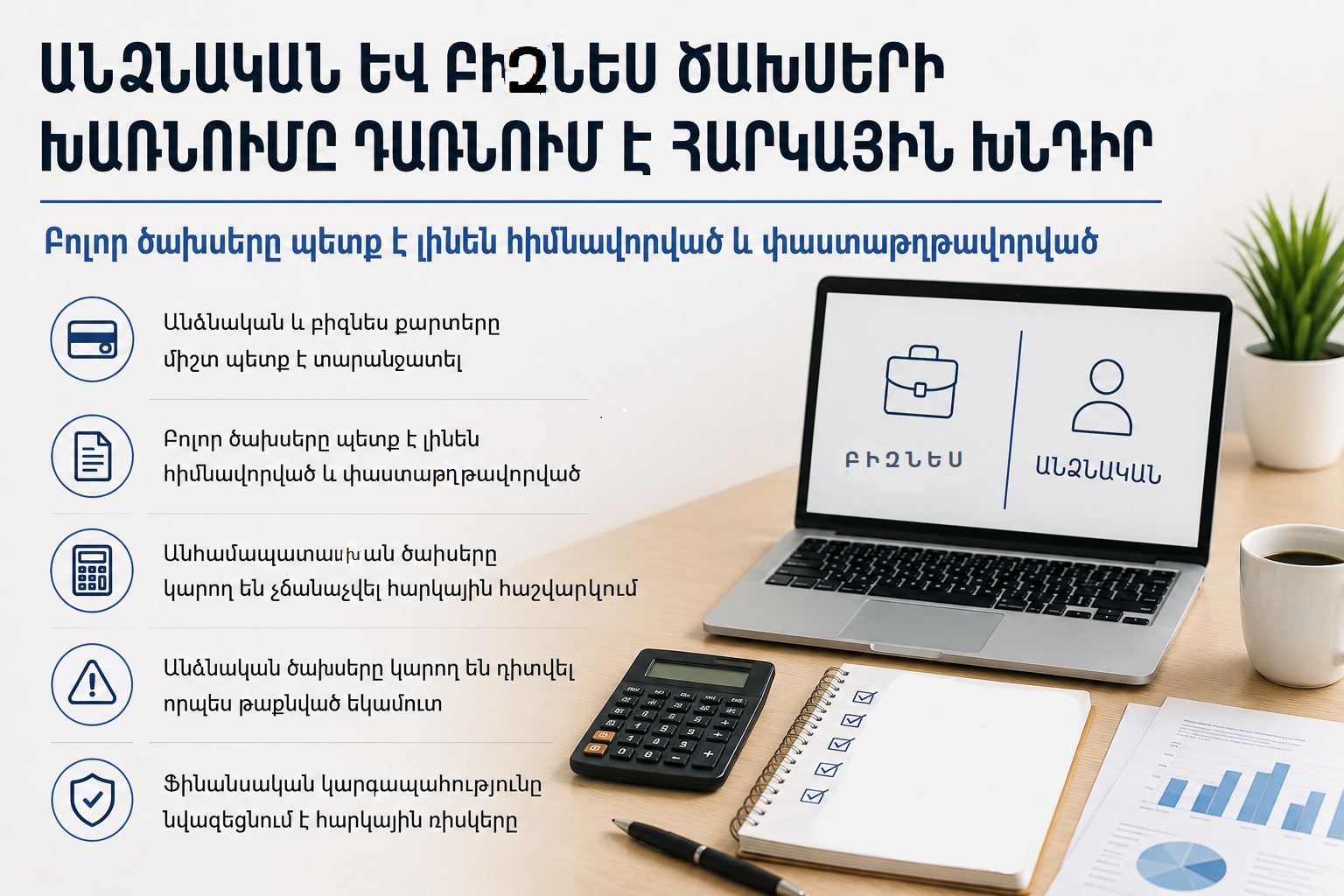
It Usually Starts with Something “Temporary”
In many businesses, this story begins very innocently. The company director urgently needs to make a payment. The corporate card is not available at that moment. Or money gets transferred to a personal account because “we’ll fix it later.” Then the company pays for the director’s personal phone bill.
Later - family travel tickets.
Then - car repairs.
Eventually, employees also begin using company cards for personal purchases. At first, it all feels convenient. But over time, a dangerous situation emerges where even the business owner can no longer clearly distinguish: where the business ends, and where personal finances begin. And that is exactly when real tax risks start to appear.
Today, Banks and Regulatory Systems See Much More Than Before
Financial oversight in Armenia has significantly increased in recent years. Bank transactions are no longer just lists of payments. They have become a financial map of a company’s behavior.
Modern systems can detect:
• frequent transfers to individuals,
- • large cash withdrawals,
- • active use of personal cards,
- • payments with unclear purposes,
- • personal expenses paid by the company,
- • and even whether the overall financial behavior appears logical for the business activity.
The risks become especially noticeable when:
- • business funds regularly flow through personal accounts,
- • “temporary” loans between the owner and company become routine,
- • company accounts are used for personal spending,
- • employees use personal cards for business transactions,
- • or the business simply lacks clear financial separation.
The Problem Is Not Only About Taxes
Many people assume the issue is only potential tax penalties. In reality, the consequences are often much broader.
1. Expenses May Be Rejected
If the company cannot demonstrate that an expense is connected to business activity, tax authorities may simply reject it.
As a result:
- • taxable profit increases,
- • additional taxes arise,
- •penalties and interest may be assessed.
2. Questions About Hidden Dividends or Personal Income May Arise
If company funds are repeatedly used for personal purposes, authorities may question whether those payments are truly business expenses, or simply personal income of the shareholder or director. In certain situations, this may create additional tax liabilities.
3. Banking Risks Also Increase
Banks today also pay close attention to financial behavior. If transactions through business accounts begin to appear illogical or overly personal, this may trigger:
- • additional compliance questions,
- • requests for documentation,
- • banking reviews,
- • or in some cases even operational restrictions.
Especially regarding international transfers.
The Most Dangerous Phrase: “We’ll Fix It Later”
In practice, the biggest problems rarely begin with large-scale fraud. They usually begin with small “temporary” decisions:
- • “Let it go through my personal card for now.”
- • “We’ll document it later.”
- • “We’ll return the money in a few days.”
- • “It’s only this one time.”
- • “Everyone does it.”
But when these “one-time” situations accumulate over months and years, the accounting structure of the business gradually loses clarity and logic. And that is when the company becomes vulnerable.
Everything Starts with Financial Discipline
In reality, many tax problems can be prevented long before they appear. The most important principle is simple:
business and personal finances should live in separate worlds.
This means:
- • separate bank accounts,
- • separate cards,
- • proper documentation,
- • justified expenses,
- • predictable financial flows,
- • and accounting oversight.
Many companies realize the importance of this only after questions already arise. But building proper financial structure early is usually much safer and far less expensive than fixing problems later.
Today, Accounting Is No Longer Just Reporting
Modern accounting is no longer simply about entering numbers into reports. A strong accounting system helps businesses:
- • reduce tax risks,
- • maintain predictable financial behavior,
- • properly separate business and personal transactions,
- • prepare for banking and tax reviews,
- • and protect the company from future problems.
That is why more businesses today are turning to professional accounting services in Armenia and experienced advisory teams. Because in many cases, serious problems do not begin with major violations - they begin with small “temporary” decisions that slowly evolve into real financial risks.