
When a Contractor Starts Looking Like an Employee: Hidden Risks for Businesses in Armenia
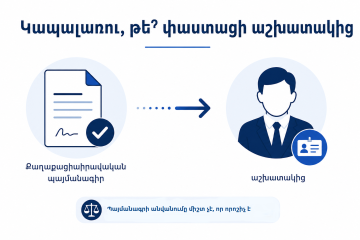
Many companies in Armenia work with employees, employment contracts, payroll calculations, staff registrations, and HR documentation. At the same time, many businesses also work with another group of people: contractors, service providers, or parties to civil-law agreements.
At first glance, this is a normal and legitimate business tool. A company needs a specific result: design work, programming, construction, marketing support, legal advice, accounting assistance, technical maintenance, or another professional service. The parties sign a civil-law agreement, the contractor provides the service or completes the work, and the company pays for the result.
The problem does not start when a company signs a civil-law agreement. The problem starts when the real substance of that agreement begins to look like an employment relationship.
Let us imagine a real business situation. A company director confidently says: “We do not have a large team. We outsource many functions to contractors. It gives us flexibility.” At first, this sounds logical. But when we begin reviewing the details, the picture changes.
It turns out that some of these contractors have been working with the same company for months. They receive almost the same payment every month. Their working day starts and ends at roughly the same time. Their tasks are assigned by the company’s manager. They participate in internal meetings, sometimes use the company’s email address, and in some cases even use the company’s equipment. If the person is unavailable for several days, the company reacts almost as if an employee is absent.
On paper, that person may be a party to a civil-law agreement. In real life, however, the relationship may be very close to employment. This is where the main risk appears. Businesses sometimes believe that if the contract is titled “service agreement” or “contract for work,” then the issue is closed. But for control bodies and experienced advisers, the title of the contract is not the only important element. What matters is the actual substance of the relationship.
In other words, what is happening in practice? Does the contractor organize the work independently, or are they subject to the company’s internal discipline? Are they paid for a specific result, or for regular monthly availability? Do they have their own tools, risks, and independent organization, or are they fully integrated into the company’s internal team?
A civil-law agreement is usually designed for situations where one party undertakes to perform specific work or provide a specific service. The logic of such a relationship is based on the result. For example, preparing a report, developing a website design, providing technical support, preparing a legal opinion, completing a marketing campaign, or delivering a specific project. An employment relationship, on the other hand, is usually based on a process: subordination, a working schedule, job duties, internal rules, and the integration of the person into the employer’s organizational structure.
In Armenian business practice, this difference is not always understood correctly. In many cases, civil-law agreements are used not because the company truly needs an independent service provider, but because it wants to avoid employment registration, vacation pay, final settlements, HR paperwork, or other employment-related obligations. This is when a civil-law agreement may stop being a protection tool and become a source of risk. When a company works with the same person for a long period and receives the same type of service from that person, several warning signs should be reviewed carefully.
The first sign is regularity. If the service is provided once or twice, the risk is usually limited. But if the same person performs the same function for several months, the company should ask itself: is this really a service, or is it a permanent role inside the company?
The second sign is the level of control. If the contractor decides independently when, where, and how to perform the work, the relationship is more likely to be civil-law in nature. But if the company tells the person when to join meetings, what time to start, what time to finish, from whom to receive tasks, and how to report every day, the relationship begins to look more like employment.
The third sign is the logic of payment. If payment is made for a specific result, project, or stage of service, this fits better with a civil-law agreement. But if the payment is the same every month, regardless of the result, and looks more like a salary, the company should be careful.
The fourth sign is integration into the internal team. If the party to the civil-law agreement has a company email address, participates in team meetings, is managed by a department head, and in practice replaces a staff employee, then the legal form of the agreement may not correspond to the real nature of the relationship.
The fifth sign is documentation. Many companies have a signed agreement, but they do not have clear acceptance acts, descriptions of completed work, project deliverables, or documents confirming the real content of the service. As a result, during an inspection or inquiry, the company may struggle to prove that the transaction was a real service rather than unregistered employment.
The tax side is also important. Payments under civil-law agreements may create personal income tax and reporting obligations. But if the relationship is later reclassified as employment in substance, the company may face additional tax, labor, and administrative risks. The issue is not only whether the correct amount of tax was withheld. The issue is also whether the company correctly classified the relationship and maintained proper documentation.
This is where experienced advisers and accounting companies in Armenia can be especially useful. A good accounting partner does not simply ask: “How much was paid?” They should also ask: who was paid, for what service, under what agreement, what documents confirm the result, and whether this person is actually performing a permanent internal function for the company. The right solution is not to stop using civil-law agreements. Businesses need them. In many cases, they are fully appropriate and necessary. The real issue is that they must be used in the right situation and structured correctly.
If a company needs a specific project, a specific result, or an external professional service, a civil-law agreement can be a very practical solution. But if the company actually needs a person who performs the same function every day, reports to a manager, follows the company’s internal rhythm, and works like a member of the team, then it may be safer to consider proper employment structuring.
Companies should periodically review their list of contractors and service providers. It is useful to separate those relationships that are one-time or project-based from those where the person has effectively become part of the company’s permanent operations.
For the second category, the company should carefully review contracts, acceptance acts, payment mechanisms, and the actual organization of work. In the end, tax and labor risks do not always begin with a major mistake. Very often, they begin with a simple phrase: “This is just a civil-law agreement.” But if behind that agreement there is permanent work, subordination, and fixed monthly payment, the business may discover too late that the problem was not in the title of the contract, but in the real substance of the relationship.
That is why every company that regularly pays contractors or parties to civil-law agreements should perform at least an annual review. Do our documents reflect reality? Are our payments taxed correctly? Are we unintentionally creating the risk of a hidden employment relationship? The safest approach for any business is simple: the contract should reflect reality, and reality should be organized in a way that allows the company to calmly explain, if needed, who provided what service, what result was delivered, and why the payment was made.