
Turnover Tax vs Corporate Tax in Armenia: Which One Is Right for Your Business?
Intro: The Most Expensive Mistake Businesses Make
One of the most common mistakes businesses in Armenia make is choosing a tax regime based on simplicity rather than long-term efficiency. At first glance, turnover tax seems attractive — it’s easy to manage, requires less accounting, and feels predictable. However, as the business grows, this “simplicity” often turns into a hidden cost.
What is Turnover Tax: Simplicity with Limitations
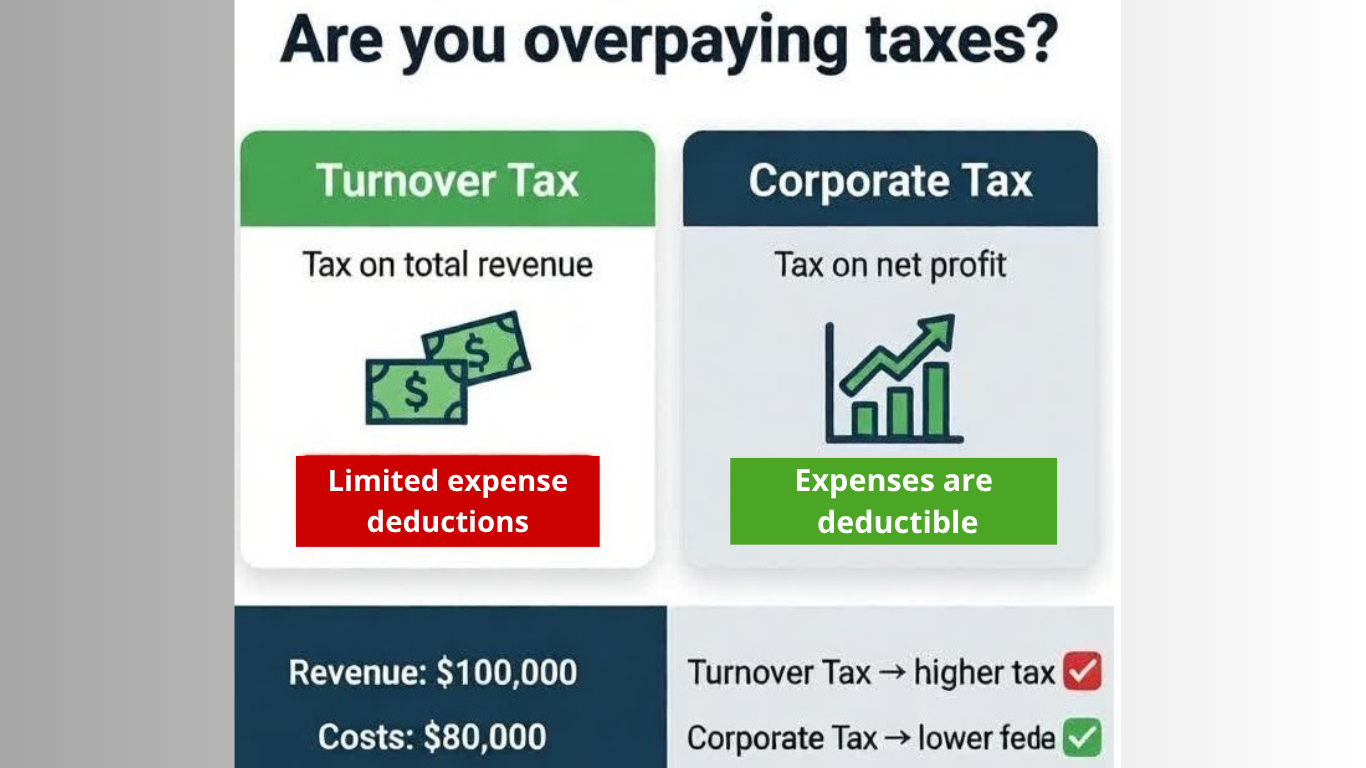
Turnover tax is calculated as a percentage of revenue, regardless of expenses.
Advantages:
- • Simple calculation
- • Lower administrative burden
- • Easy to start with
Limitations:
- • Expenses are not deductible
- • No optimization opportunities
- • Can become expensive as margins shrink
In practice, businesses with growing costs often end up overpaying.
What is Corporate Tax: Flexibility and Structure
Corporate tax is based on profit — revenue minus expenses.
Advantages:
- • Expenses are deductible
- • Allows tax planning
- • More suitable for scaling companies
Challenges:
- • Requires proper accounting
- • More structured approach
However, this structure is exactly what allows businesses to optimize their tax burden.
Comparison Table
|
|---|
When is Each System profitable?
Turnover Tax is suitable when:
- • Low expenses
- • Small or early-stage business
- • No complex structure
Corporate Tax is better when:
- • Expenses are significant
- • Business is scaling
- • You want to optimize taxes
Common Mistakes
- • Choosing turnover tax only because it is “simple”
- • Not reviewing the tax regime as the business grows
- • Ignoring the impact of expenses
- • Delaying the transition to corporate tax
Conclusion
Taxes are not just about rates — they are about structure. The right tax regime can significantly improve your financial efficiency, while the wrong one can silently reduce your profitability.
Soft CTA:
If you are unsure whether your current tax system is optimal, it is usually a good moment to review it. In many cases, a short discussion is enough to identify potential inefficiencies.